Liquefaction of sands

Micromechanics of granular media
Multi-scale random fields in geomechanics
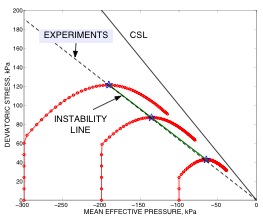
The onset of liquefaction can be predicted by constitutive modeling via calculation of a critical plastic modulus. The method has already been shown to accurately reproduce static liquefaction as observed in triaxial tests on loose sands. This research is currently being expanded to predict potentially unstable regions of slopes using finite element methods. Soon, the constitutive model will be enhanced to allow for the prediction of liquefaction caused by cyclic loading.
A quantitative methodology has been developed that regularizes the numerical calibration procedure for explicit DEM schemes to achieve solution convergence and quasi-static states. One ongoing topic is to investigate the microscopic failure mechanism for granular materials using relevant numerical tools. Also, efforts are being made to develop a multi-scale framework that bridges microscopic models with traditional macroscopic models to capture granular material behaviors under dramatically different conditions spanning homogeneity to discontinuity.
In this research, the multi-scale nature of soil behavior is explicitly accounted for by obtaining the mechanical response of geosystems using an accurate multi-scale hierarchical computational framework. It is well known that the behavior of particulate media, such as sands, is encoded at the granular-scale and hence methods for up-scaling such behavior across relevant scales of interest—from granular-scale (~1mm) to field-scale (>1m)—are needed to attain a more accurate prediction of soil behavior. Multi-scale analysis is especially important under extreme conditions such as strain localization, penetration or liquefaction, where the classical constitutive description may no longer apply. Several unanswered questions illustrate the importance of studying such phenomena: What material parameterizations are most appropriate at various scales? What are the relevant scales needed for an accurate material description? What are the impacts of uncertainties and inhomogeneities on field-scale behavior? A probabilistic framework across multiple scales is needed to answer these questions and to consistently compute the behavior of the material across scales.
In an unprecedented fashion, probabilistic models for soil porosity are developed at multiple scales, using experimental results from X-Ray computed tomography to study spatial correlation down to the millimeter scale. From a computational standpoint, the multi-scale framework is demonstrated using well-established models for sands. In this hierarchical approach, a more accurate material description—at finer scales—is pursued only in the presence of strong inhomogeneities, either material or imposed (e.g. by deformations). The hierarchical approach is based on passing the macroscopic deformation down to the finer scale(s) and then returning more accurate, averaged stresses. Monte Carlo simulation is used to generate material properties in a hierarchical manner, so that fine scale material data can be obtained whenever necessary, conditional upon previously simulated coarse scale data. These modeling approaches will be developed and then used in several parametric and validation studies to bring insight to practical problems where multi-scale effects are important. Multi-scale modeling opens the door to develop design-specific engineering systems with desirable qualities or properties, and will allow scientists and engineers to better understand the role of finer scales on the behavior of complex geotechnical systems.
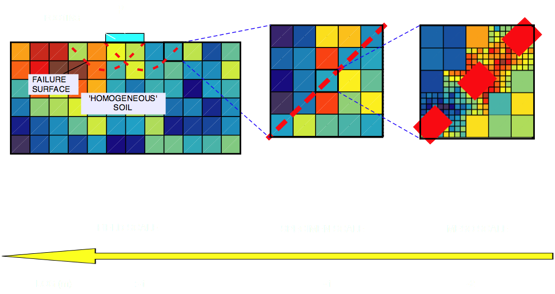
Image from Andrade (2008)
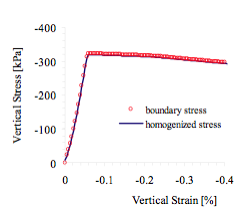
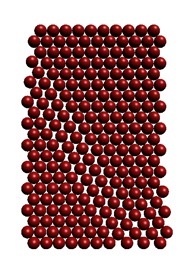
Images from Tu and Andrade (2008)
Collaborator: Professor Jack W. Baker, Stanford University
Project Sponsor: NSF

Copyright © 2007 by Jose E. Andrade
Disclaimer: The contents of this website are free to use so long as credit is given to the Copyright owner
Multiscale Method for Granular Media
A predictive multiscale framework has been developed for modeling the behavior of granular mate-
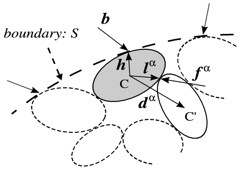
rials. The method is particularly attractive due to its simplicity and ability to exploit the existing finite element and computational inelasticity technologies. Furthermore, this semi-concurrent multiscale method extracts two key material parameters from the granular structure: dilatancy and frictional resistance. The evolution of these material parameters is upscaled into classical plasticity models, effectively bypassing phenomenological hardening laws. The predictiveness of the method has been demonstrated by comparing its performance with experimental results and direct numerical simulations under homogeneous and inhomogeneous conditions.
As the numerical scheme for the multiscale method, a semi-implicit return mapping algorithm is developed for integrating generic nonsmooth elastoplastic models. The semi-implicit nature of the algorithm stems from ‘freezing’ the plastic internal variables at their previous state, followed by implicitly integrating the stresses and plastic multiplier. The plastic internal variables are incrementally updated once convergence is achieved (a posteriori). This method is able to integrate nonsmooth (C0) evolution laws that may not be integrable using implicit methods. Though accuracy of the proposed algorithm is step size-dependent, its simplicity and its remarkable ability to handle nonsmooth relations make the method promising and computationally appealing.
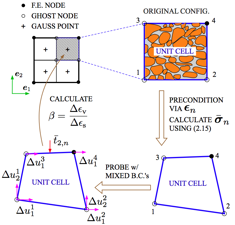
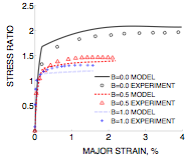
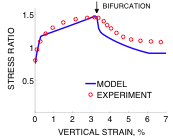
Images from Andrade and Tu (2008)
Collaborator: Professor Ted Belytschko, Northwestern University
Project Sponsor: AFOSR

At the nano scale, cement paste is believed to be composed of tiny basic units of calcium-silicate-hydrate (C-S-H) colloids with a characteristic length of 5 nm. These units cannot be directly seen in a microscope, but a vast array of experimental information about its properties have been determined using experimental methods such as gas adsorption, small-angle neutron scattering, calorimetry, electron microscopy, and nanoindentation. Using indirect information about specific surface area, density, elastic modulus, and nucleation and growth mechanisms, a discrete element model of over 4 million particles with Hertzian contacts is being developed. These particles, believed to act as a granular material, have granular properties such as friction and cohesion along with the Van
der Waals forces that take effect at the nano scale.
Discrete element modeling of the nanostructure of cement paste
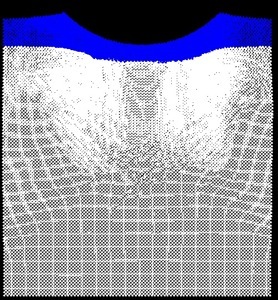
Currently, nanoindentation simulations on the model are being used to test predictions of properties such as indentation modulus, packing density, stress distributions, etc. The goal is therefore to use the nanostructure of C-S-H to predict bulk properties in cement paste, such as shrinkage and creep. By accurately predicting such properties, we hope to use the model to gain a greater understanding of macro-level characteristics with a long-term goal of developing new types of cementitious materials.
Partially saturated media
Thus far, a new constitutive relationship for drying of porous materials has been developed and shown to greatly improve the strain predictions in cement- and glass-based porous media. Examining the implications of these results with respect to the classic expression of the effective stress in partially saturated media, largely unchanged in its form since the publication in the early 1960s, is an ongoing topic of interest. Efforts to incorporate the aforementioned material-point laws into an efficient FEM framework and thus to apply the results to the more complex boundary-value problems is also under way.
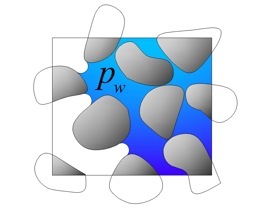
Constitutive laws that are based more on the physical mechanisms and less on the phenomenological attributes provide better predictions of material response and at the same time require less parameter calibration. One current topic being explored is an application of this maxim to materials whose pore spaces contain two or more fluids, i.e. partially saturated materials.